Laminated vs Solid Log Homes
Which wall system fits your build, your budget, and your long-term maintenance expectations.
Solid log construction is the traditional method and it produces the look most people picture when they imagine a log cabin. Laminated log construction is the engineered alternative, built from bonded layers rather than single timbers, and its main advantage is that the walls do not settle. Solid logs generally cost less up front and cost more to maintain. Laminated logs cost more up front and less to maintain. Neither is universally better — here is how they differ on the points that actually affect the build.
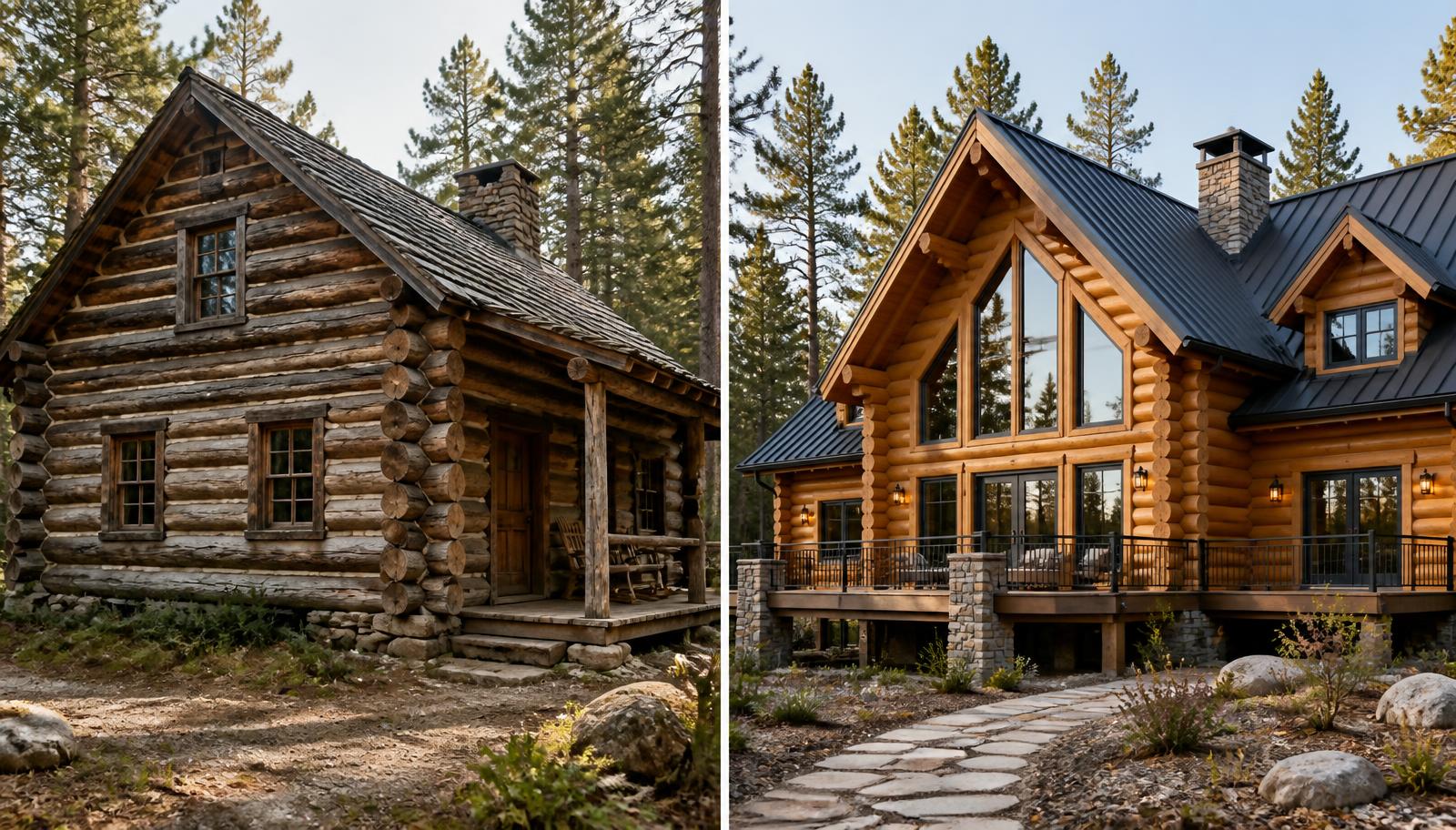
Side-by-Side Comparison
| Factor | Solid log homes | Laminated log homes |
|---|---|---|
| Wall construction | Single stacked timbers | Bonded layers of kiln-dried lumber |
| Settling | Ongoing; requires allowances and adjustments | Minimal; walls stay dimensionally stable |
| Chinking and sealing | Periodic re-chinking and sealing over life | Generally not required after initial seal |
| Maintenance over time | Higher — settlement, jacks, re-sealing | Lower — mainly exterior finish upkeep |
| Upfront material cost | Usually lower | Usually higher |
| Long-term cost | Higher lifetime maintenance | Lower lifetime maintenance |
| Span and opening size | Limited by solid timber size | Larger spans and openings possible |
| Build schedule | Longer; may need acclimation before finish work | More predictable; finish work proceeds sooner |
| Traditional appearance | Stronger hand-hewn, rustic character | Cleaner, more uniform milled appearance |
| Manufacturer availability | More mills and regional suppliers | Fewer specialized manufacturers |
Settling — The Difference That Affects Everything Else
In a traditional solid log home, the timbers continue to dry and acclimate after the walls are stacked. As moisture leaves the wood, the logs shrink slightly in height. That small movement, repeated across every course, creates settling — the wall system gets shorter over time.
Settling drives a long list of downstream details. Doors and windows need settling allowances above their frames so they are not compressed as the wall drops. Posts and beams may sit on adjustable screw jacks that need periodic tightening. Interior finishes, cabinetry, and mechanicals attached to log walls have to be detailed so they do not bind. And chinking — the seal between logs — has to be inspected and touched up as gaps open and close.
Laminated logs remove that variable. Because the lumber is kiln-dried and bonded before milling, the timber arrives at the site already stable. Once the wall is standing, it does not shrink meaningfully, so openings, finishes, and mechanicals can be detailed the same way they would be in a conventional home. That stability is the central engineering advantage of the laminated system.
Maintenance Over Twenty Years
Both wall systems need exterior finish maintenance. Sun, rain, and UV break down coatings on any wood surface, solid or engineered. The difference is in the structural maintenance items that come with settling.
A solid log home typically needs periodic re-chinking to keep the seal between logs, especially in the first several years as the wood reaches equilibrium. Screw jacks under posts may need adjustment. Gaps can open around doors and windows if settling allowances were not generous enough or if finishes were attached too rigidly. None of this is catastrophic, but it is a recurring ownership task.
A laminated log home avoids most of those items. The chinking or seal installed at construction generally stays put, and there are no jacks to adjust. That does not make it maintenance-free — exterior finishes still need care — but the maintenance list is shorter and more predictable.
Cost Over Time
The upfront cost story usually favors solid logs. The material itself is less expensive, more regional mills supply it, and the package price is often lower than an engineered laminated package for a similar footprint.
The lifetime cost story can favor laminated logs. The absence of settling-related maintenance, re-chinking, and jack adjustment shifts spending from the back end of ownership to the front end of construction. A shorter, more predictable build schedule can also reduce carrying costs on a construction loan.
Which one wins depends on how long the owner keeps the home. Someone building a small seasonal cabin and selling within five years may never see the long-term savings of laminated construction. Someone building a full-time residence they plan to own for decades may. For a detailed look at current pricing, see our guide to laminated log cabin cost.
When Solid Logs Are the Better Choice
- Budget is the binding constraint and upfront cost matters more than lifetime cost. If the build needs to hit a lower initial number and the owner accepts the ongoing maintenance, solid logs can be the practical choice.
- The homeowner specifically wants a hand-hewn or full-scribe traditional appearance. Nothing replicates the look of a stacked solid timber wall with natural checking and variation.
- A local mill or supplier makes solid logs substantially cheaper in that market. In some regions, solid logs are a local commodity and laminated packages have to be shipped long distances.
- The build is a smaller cabin or seasonal structure where long-term maintenance matters less. If the home is used lightly and sold before major maintenance cycles arrive, the upfront savings may outweigh the lifetime costs.
When Laminated Logs Are the Better Choice
- A full-time residence where maintenance burden matters. Owners who live in the home year-round feel every maintenance item more acutely.
- Large window openings or long clear spans in the design. Engineered timbers perform better when openings or spans push the limits of solid timber.
- A climate with significant humidity or temperature swings. Stable, dry-assembled walls handle cycling moisture better than solid logs that are still acclimating.
- The owner wants a predictable build schedule. Removing the acclimation and settling periods makes finish work easier to schedule.
- Modern or transitional architectural style rather than traditional rustic. The uniform milled profile fits cleaner, more contemporary designs.
Frequently Asked Questions
Are laminated logs real wood?+
Yes. Laminated logs are made from real lumber layers that are kiln-dried, bonded under pressure, and milled into a structural timber. They are engineered wood, not synthetic, and they perform like a solid timber once installed.
Do laminated log homes look different from solid log homes?+
They can. Laminated logs are usually precision-milled to a uniform profile, which gives a cleaner, more consistent look. Solid logs retain more natural variation, checking, and the hand-hewn character many people associate with a traditional cabin. The visible difference depends on species, profile, and finish.
Which lasts longer?+
Both can last for generations when properly built, detailed, and maintained. Solid logs may need more frequent sealing, chinking, and settlement adjustment over their life. Laminated logs avoid settling-related wear but still need exterior finish maintenance appropriate to the species and climate.
Do laminated log homes resell as well?+
It depends on the market. In areas where log homes are common and appraisers have comparable sales, resale is straightforward. In markets where log construction is rare, either wall system can be harder to appraise. A well-documented build by a licensed contractor helps either type.
Can you mix both in one home?+
Sometimes. A design might use solid logs for visible exterior walls and laminated or conventional framing for interior partitions, great rooms, or structural elements where settling would be difficult to detail. Mixing requires careful engineering at the interfaces.
Still comparing wall systems?
Tell us about your site, your budget, and the look you want, and we will connect you with builders who have experience with the system that fits your project. Read more about laminated log cabins or find a builder now.
Get Matched With a Log Home Builder Near You
Tireless Construction is a nationwide network that connects homeowners with qualified, licensed local custom home builders and framing contractors — free, with no obligation.
Request Your Free Project Consultation
Tell us about your build. We will connect you with experienced log home builders in your area.